
What Is Industrial Sourcing & Procurement and Why Manufacturers Outsource It
Introduction: Industrial sourcing is more than finding a supplier
For a manufacturer, purchasing a component or industrial product is rarely as simple as finding a supplier and comparing prices.
The supplier must be able to meet the required technical specification, quality level, quantity, lead time, documentation, and commercial terms. If the item is imported, logistics, customs, delivery terms, and cross border communication add another layer of complexity.
This is where industrial sourcing and procurement become strategic business functions.
Effective sourcing helps manufacturers identify and evaluate suitable suppliers. Procurement turns those sourcing decisions into controlled purchasing activities from quotation and negotiation to ordering, supplier coordination, and delivery.
For companies with limited procurement resources, international sourcing requirements, or technically complex purchasing needs, outsourcing part of this work can provide access to specialist knowledge and supplier networks without building a larger internal team.
What Is Industrial Sourcing?
Industrial sourcing is the process of identifying, researching, evaluating, and selecting suppliers that can meet a company’s technical, commercial, and operational requirements.
In manufacturing, sourcing may cover raw materials, components, machinery, spare parts, castings, tools, MRO products, or other industrial goods.
A professional sourcing process normally considers more than unit price. Depending on the category, buyers may assess:
- Technical compliance with specifications
- Product and material quality
- Supplier capabilities and production capacity
- Certifications and documentation
- Lead times and minimum order quantities
- Commercial terms and payment conditions
- Delivery terms and logistics requirements
- Supplier reliability and communication
- Long-term supply continuity
The objective is not simply to find the cheapest supplier. It is to identify a supplier that can deliver the required product, at an acceptable total cost, with the level of reliability the business needs.

What Is Industrial Procurement?
Industrial procurement is the broader process of acquiring the goods and services a company needs to operate or manufacture.
It can include requirements definition, supplier selection, quotation management, negotiation, purchase orders, contracts, delivery coordination, documentation, and supplier relationship management.
A useful distinction is:
Sourcing asks: “Who can supply what we need, and under what conditions?”
Procurement asks: “How do we acquire it efficiently, reliably, and under controlled commercial terms?”
In practice, the two functions are closely connected. Poor sourcing can create procurement problems later, while weak procurement processes can reduce the value created by good supplier selection.
Industrial Sourcing vs. Procurement: What’s the Difference?
Although the terms are often used together, they describe different parts of the purchasing cycle.
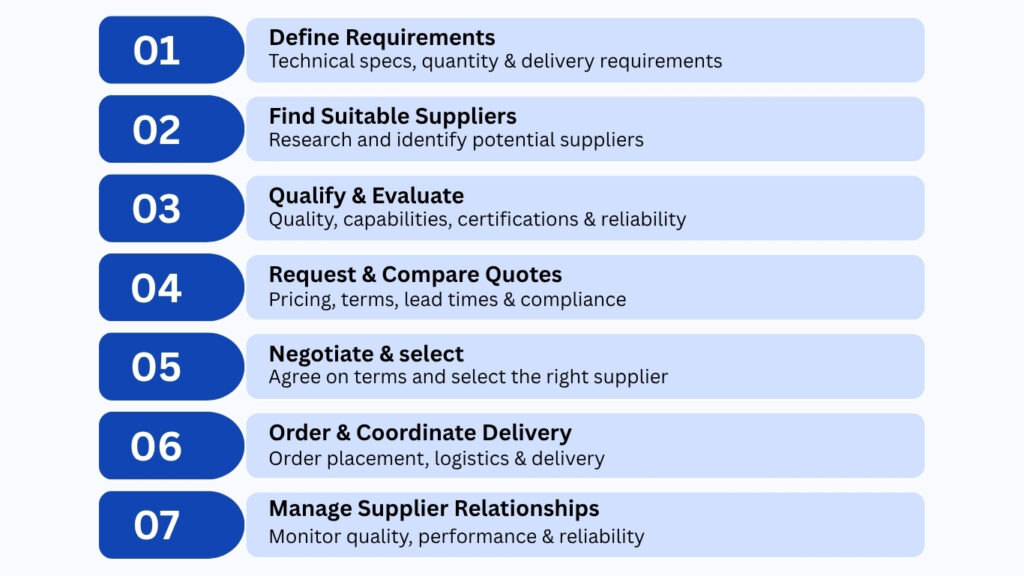
A Practical Industrial Sourcing & Procurement Process
A structured process reduces avoidable supplier and purchasing risks.
1. Define the requirement
Start with the technical specification, quantity, required standards, target delivery date, and any documentation requirements.
2. Research the supplier market
Identify manufacturers, distributors, and other relevant suppliers that can potentially meet the requirement.
3. Screen and qualify suppliers
Review capabilities, experience, production capacity, quality systems, certifications, references, and other relevant criteria.
4. Request and compare quotations
A useful RFQ should make supplier responses comparable. Compare not only price, but also lead time, Incoterms, payment terms, MOQ, validity, and technical compliance.
5. Evaluate, negotiate and select
For complex industrial products, technical suitability should be confirmed before commercial differences are treated as decisive. Negotiate the relevant commercial and contractual terms and select the supplier that provides the appropriate balance of cost, quality, capability, and supply reliability.
6. Place the order and coordinate delivery
Procurement continues after supplier selection. Orders, production milestones, documentation, shipping, and delivery may all require follow-up.
7. Review supplier performance
For recurring purchases, supplier performance should be monitored over time so that problems are identified and sourcing decisions can be improved.
Why Is Industrial Sourcing Difficult for Manufacturers?
Manufacturers face a different sourcing environment from ordinary business purchasing.
Technical requirements matter. A supplier may offer an attractive price but still be unsuitable if a material grade, tolerance, dimension, certification, or performance requirement is not met.
Supply continuity matters as well. A late component can affect production schedules, customer deliveries, and inventory planning.
International sourcing adds further complexity. Companies may need to manage different markets, languages, commercial practices, delivery terms, customs requirements, and documentation.
Finally, procurement teams are often expected to manage these responsibilities while also handling day to day purchasing. That can leave limited time for supplier development, market research, alternative source identification, and strategic cost management.
Why Do Manufacturers Outsource Sourcing & Procurement?
Outsourcing does not necessarily mean giving up control of purchasing. It can mean delegating selected sourcing or procurement activities to a specialist while the manufacturer retains the decisions and controls that matter most.
There are several common reasons manufacturers consider this model.
1. Access to a broader supplier network
A sourcing partner can help a manufacturer reach suppliers and markets that are difficult to identify or evaluate internally. This can be particularly useful when entering a new geographic market or looking for alternative sources.
2. Reduce the workload on internal teams
Supplier research, RFQs, quotation comparison, communication, documentation, and follow-up can consume substantial internal time. Outsourcing selected activities can allow internal teams to focus on production, engineering, customers, and higher-value procurement decisions.
3. Improve supplier discovery and comparison
External sourcing support can introduce additional supplier options and a more structured comparison process. The value comes from better market coverage and disciplined evaluation not simply from collecting more quotations.
4. Support international purchasing
Cross border procurement can involve unfamiliar suppliers, logistics requirements, commercial terms, and communication challenges. A partner with relevant market and supplier experience can help coordinate these activities.
5. Scale procurement without immediately expanding headcount
A manufacturer may need additional sourcing capacity for a project, a new product, a new supplier category, or a temporary increase in purchasing volume. Outsourcing can provide additional capacity without requiring a permanent internal procurement structure.
6. Access specialist knowledge
Some industrial categories require technical understanding as well as commercial purchasing skills. A sourcing partner that understands specifications, product categories, and supplier capabilities can help bridge the gap between technical requirements and supplier selection.

When Should a Manufacturer Consider Outsourcing Procurement?
Outsourcing can be worth evaluating when:
- Your procurement team is spending too much time on supplier research and routine purchasing
- You need suppliers in a market where you have limited contacts
- You are sourcing technically specific industrial products or components
- You need alternative suppliers or a second source
- You are entering a new product category or geographic market
- Procurement workload has increased faster than internal capacity
- You want to test an external sourcing model before expanding your permanent team
Outsourcing does not have to be all or nothing. A manufacturer can outsource a specific category, sourcing project, market, or procurement activity while keeping strategic decisions in house.
What Should You Look for in an Industrial Sourcing Partner?
The quality of the sourcing partner matters as much as the decision to outsource.
Look for a partner that can demonstrate:
- Understanding of industrial products and technical specifications
- Access to relevant and credible suppliers
- A clear supplier qualification process
- Transparent quotation comparison
- Strong communication and follow up
- Awareness of logistics and delivery requirements
- Clear documentation and commercial processes
- The ability to work within your existing procurement workflow
A good partner should make the process more controlled not less transparent. Manufacturers should understand how suppliers are selected, how quotations are compared, and what information is available before a purchasing decision is made.
How Duna Supports Industrial Sourcing & Procurement
At Duna, we work with industrial products, equipment, and suppliers across European markets.
Our sourcing approach is built around understanding the requirement first, identifying suitable supply options, and coordinating the commercial and practical steps needed to move a purchase forward.
Depending on the project, this can include supplier identification, product sourcing, quotation coordination, supplier communication, purchasing support, and delivery coordination.
For manufacturers and industrial businesses, the goal is straightforward: make it easier to access suitable suppliers and products without adding unnecessary complexity to the internal team.
Conclusion: Procurement is part of the manufacturing operation
Industrial sourcing and procurement are not simply administrative purchasing activities. The suppliers a manufacturer chooses can affect product quality, production continuity, delivery performance, and overall operating costs.
For some companies, keeping every procurement activity in house makes sense. For others, outsourcing selected sourcing or procurement tasks can provide additional supplier access, expertise, and capacity.
The right approach depends on the company’s products, purchasing categories, internal resources, and supply chain requirements.
If your business is looking for industrial suppliers, components, equipment, or sourcing support in European markets, Duna can help you evaluate the available options and coordinate the purchasing process.
Contact Duna to discuss your sourcing requirements.
Recommended FAQ Section
What is industrial sourcing?
Industrial sourcing is the process of identifying, evaluating, and selecting suppliers for industrial products, components, materials, equipment, or services based on technical, quality, commercial, and operational requirements.
What is the difference between sourcing and procurement?
Sourcing focuses primarily on finding and evaluating suppliers and negotiating supply options. Procurement covers the broader purchasing process, including ordering, contracts, supplier coordination, and delivery.
Why do manufacturers outsource procurement?
Manufacturers may outsource selected procurement activities to access supplier networks, reduce internal workload, support international purchasing, add specialist capacity, or scale procurement without immediately increasing headcount.
Can procurement outsourcing be partial?
Yes. Companies can outsource specific sourcing projects, categories, markets, or transactional activities while keeping strategic procurement decisions and supplier governance internally.
What should manufacturers consider when choosing a sourcing partner?
Relevant factors include industrial and technical knowledge, supplier access, qualification methods, transparent quotation comparison, communication, logistics coordination, documentation, and fit with the manufacturer’s procurement process.