
OEM Production in Europe: What International Buyers Should Verify Before Signing
A competitive OEM quotation does not necessarily mean a qualified manufacturing partner. For international buyers, the real risk often appears after the purchase order: inconsistent quality, unclear documentation, limited capacity, unexpected subcontracting, delayed deliveries, or disputes over tooling and specifications.
Before signing an OEM manufacturing agreement in Europe, buyers should therefore verify more than price. They should verify the supplier’s legal identity, production capability, quality controls, applicable compliance requirements, capacity, logistics responsibilities and contractual obligations.
This guide provides a practical framework for evaluating OEM manufacturing in Europe before committing significant volume. The principle is simple: move from supplier claims to evidence.
What Should International Buyers Verify Before Signing an OEM Agreement?
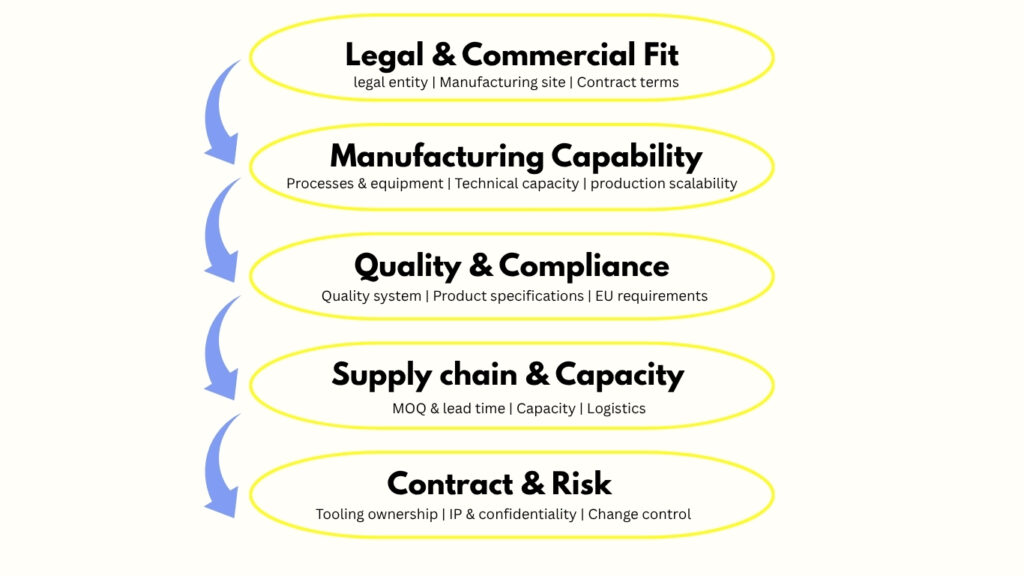
A robust supplier review should cover five areas: legal and commercial fit; manufacturing capability; quality and compliance; supply-chain and capacity risk; and contract protection. These areas are connected. A supplier may have excellent equipment but weak documentation, or strong quality controls but insufficient capacity for your forecast.
The buyer’s objective
Do not ask only, “Can this supplier make the product?” Ask, “Can this supplier repeatedly make the required product, to the agreed specification, at the required volume, under the applicable compliance framework, and with clearly defined commercial responsibilities?”
1. Start With the Requirement, Not the Supplier
Supplier qualification becomes much more reliable when the buyer has already defined what success looks like. Before comparing manufacturers, prepare a controlled technical and commercial requirement.
- Product drawings, specifications and revision level
- Materials, grades and required properties
- Critical dimensions and tolerances
- Surface finish, coating or treatment requirements
- Testing and inspection requirements
- Packaging and labeling requirements
- Expected annual volume, order pattern and forecast
- Target market and applicable regulatory requirements
- Required documentation and traceability
- Target delivery point and preferred commercial terms
If these inputs are unclear, supplier quotations are difficult to compare. Two manufacturers may quote different assumptions while appearing to quote the same product.
2. Qualify the Supplier Across Five Dimensions
Instead of treating supplier selection as a price comparison, use a structured qualification process.
| Qualification Dimension | What to Verify | Evidence to Request |
|---|---|---|
| Legal & Commercial Fit | Legal entity, actual manufacturing site, commercial terms, and contractual responsibilities. | Company registration details, factory address, references, and draft contract terms. |
| Manufacturing Capability | Production processes, equipment, technical expertise, available capacity, and ability to scale. | Process descriptions, equipment list, technical capabilities, production records, and sample parts. |
| Quality & Compliance | Quality controls, product specifications, testing procedures, traceability, and applicable EU requirements. | Quality procedures, inspection reports, test results, relevant certificates, and product compliance documents. |
| Supply Chain & Capacity | Minimum order quantity (MOQ), lead times, material sourcing, production capacity, and logistics arrangements. | Capacity plans, lead-time estimates, material sourcing details, delivery schedules, and logistics terms. |
| Contract & Risk | Tooling ownership, intellectual property (IP), confidentiality, change control, liability, and dispute resolution. | Tooling agreements, confidentiality agreements, IP clauses, quality agreements, and contract provisions. |
3. Verify the Legal Entity and Actual Manufacturing Site
Do not evaluate a supplier only through its website, sales office or trading name. Confirm the legal entity that will sign the agreement and invoice the goods, and identify the actual facility responsible for production.
- Legal company name, registration details and registered address
- Production-site address and relationship to the contracting entity
- Whether manufacturing is owned, leased or outsourced
- Whether subcontracted operations are disclosed and controlled
- Export experience and relevant customer references
- Whether contracting, invoicing and bank-account details are consistent
For significant projects, an audit or structured factory assessment can help validate stated capability. A virtual tour can support initial screening, but it should not replace document review, samples, production evidence and contractual controls.
4. Verify Technical Capability and Process Fit
A factory can have modern equipment and still be the wrong supplier for a specific product. Capability should be assessed against the actual process, material, tolerance, finish, testing and volume requirements.
- Relevant machines, tooling and manufacturing processes
- Engineering and technical support
- Inspection and measurement equipment
- Material handling and traceability
- Experience with comparable products or process complexity
- Ability to maintain critical tolerances at production volume
- Controls over outsourced or special processes
Ask the supplier to explain the product’s critical-to-quality characteristics and how each is controlled. This is usually more informative than a general statement that the factory uses “advanced technology.”
5. Verify Quality Not Just Certificates
Quality should be evaluated as a production system, not as the result of one good sample. Review incoming material controls, in process inspection, final inspection, non conformance handling, corrective actions, calibration and document control.
ISO 9001 is a globally recognized quality-management standard. ISO published ISO 9001:2026 in September 2026, replacing ISO 9001:2015. Certification is not mandatory, and certification alone does not prove that a supplier can manufacture your particular product successfully.
Do not ask only for a certificate.
Ask what the certificate covers: the legal entity, site, scope and validity. Then ask for product-relevant evidence such as inspection reports, test reports, traceability records or examples of corrective-action processes.
- Incoming material inspection
- In-process and final inspection
- Measurement equipment and calibration
- Non-conformance and corrective-action procedures
- Batch or lot traceability where required
- Engineering-change and document-control procedures
6. Verify EU Compliance and Do Not Treat CE as a Generic Certificate
Compliance is product and market specific. Before asking a supplier for a certificate, determine which EU legislation applies to the product and what conformity route is required.
Important: CE marking is not a universal EU approval certificate.
The European Commission states that not all products require CE marking. Where CE marking is applicable, the relevant conformity requirements depend on the product and the legislation covering it. CE marking does not indicate that a product has been approved as safe by the EU or another authority.For products covered by applicable EU rules, the buyer should understand who carries the relevant legal responsibilities. When products are imported from outside the EU, importers have specific obligations to verify compliance and documentation. If an importer or distributor markets a product under its own name, it can take on the manufacturer’s responsibilities under applicable rules.
- Which EU legislation applies to the product?
- Is CE marking actually required?
- Who is the legal manufacturer for the relevant product legislation?
- Is an EU Declaration of Conformity required and available?
- Is technical documentation available where required?
- Which standards and tests were used, and for which exact product/model?
- Are labeling, instructions and traceability requirements defined?
- Where relevant, have chemical/material obligations such as REACH been considered?
REACH is the EU framework for managing risks from chemical substances and places responsibilities on industry to manage chemical risks and provide safety information. Its relevance depends on the substances and product context.

7. Use Samples and Pilot Production as Evidence
A showroom sample is not the same as production validation. For higher risk or technically demanding products, the most useful evidence is a sample or pilot batch made using the intended production process, materials and tooling.
- Define measurable acceptance criteria before production.
- Approve a controlled reference sample or specification.
- Agree inspection methods and responsibility.
- For appropriate projects, consider buyer or independent third party inspection.
- Define how rejected or non-conforming goods will be handled.
- Keep the approved sample, specification and inspection criteria aligned.
8. Verify Production Capacity and Scalability
“We can produce your required volume” is a claim that needs context. Ask how capacity is calculated and whether relevant machines, shifts, materials and subcontracted processes can support demand when the order is placed.
- Current production load
- Relevant machines and available production time
- Number of shifts
- Bottleneck processes
- Material availability and procurement lead times
- Subcontracted processes and their capacity
- Peak period constraints
- Ramp up plan if volumes increase
A supplier that can successfully manufacture 1,000 units does not automatically have a stable process for 10,000 units. If growth is expected, discuss the ramp up scenario before signing.
9. Don’t Compare OEM Suppliers by Unit Price Alone
A low unit price can become expensive if it comes with higher tooling costs, weak packaging, additional inspection, longer lead times, quality failures or an MOQ that creates excessive inventory.
Compare suppliers using the same assumptions across the total procurement cost:
- Unit price
- Tooling and setup
- Packaging and labeling
- Inspection and testing
- Documentation or compliance-related costs
- Freight and logistics
- Duties and taxes where applicable
- Potential rework, rejection or replacement costs
- Inventory and working-capital impact
- Procurement principle: The cheapest quotation is not necessarily the lowest-cost supply option. Compare like-for-like specifications and calculate the commercial assumptions behind the quoted price.
10. Clarify MOQ, Lead Time and Change Control
Lead time should be defined as a process rather than a single number. Clarify when the lead time clock starts and what it includes.
- Raw material procurement
- Tooling or setup
- Sample approval
- Production
- Inspection and rework
- Packaging
- Export documentation
- Handover to the carrier
Also define whether MOQ applies per order, SKU, material or production run. For forecasts, clarify what is binding and what is indicative.
Establish change control. Material substitutions, process changes, tooling changes, subcontracting changes or design revisions should not be treated as informal details when they can affect product performance.
11. Define Logistics and Incoterms® Precisely
International OEM transactions should identify the applicable Incoterms® rule and named place. Incoterms® 2020 allocates important buyer and seller responsibilities, including certain transport obligations, costs and risks.
- Exact Incoterms® rule and named place/point
- Who arranges and pays for transport
- Export and import clearance responsibilities
- Required shipping and customs documentation
- Packaging and loading requirements
- Point of delivery and transfer of risk
- Delivery-performance measurement
Avoid vague commitments such as “delivery to Europe.” The contract should make the delivery point, responsibilities and assumptions unambiguous.
12. Protect Tooling, Intellectual Property and Confidentiality
If the buyer funds molds, dies, patterns, fixtures or dedicated equipment, ownership and access should be explicit before production begins.
- Who owns customer-funded tooling?
- Where is tooling stored?
- Who pays for maintenance and replacement?
- Can the supplier use the tooling for another customer?
- Who owns drawings, CAD files, specifications and product improvements?
- What confidentiality restrictions apply?
- What happens to tooling, files and confidential information when the relationship ends?
For proprietary products, use written contractual protections rather than relying on informal assurances.
13. Put the Requirements Into the Contract
Supplier qualification is only useful if agreed requirements survive into the contract and purchase order process.
| Contract area | Define clearly |
|---|---|
| Technical specification | Revision-controlled drawings/specifications, materials, tolerances and approved changes |
| Quality | Inspection methods, testing, defect definitions and acceptance procedure |
| Delivery | Lead-time definition, delivery point and agreed consequences of delay |
| Quantity | MOQ, order quantities, tolerances and forecast assumptions |
| Documentation | Required certificates, reports, declarations and shipping documents |
| Tooling/IP | Ownership, permitted use, maintenance and transfer/return conditions |
| Change control | Approval requirements for material, process, design or subcontracting changes |
| Non-conformance | Correction, replacement, credit, rejection and investigation process |
| Confidentiality | Confidential information, permitted use and post-termination obligations |
A Practical OEM Supplier Qualification Process
Supplier qualification works best as a staged process. Each stage should reduce uncertainty before the next commercial commitment.
| Stage | Buyer objective |
|---|---|
| 1. Define the requirement | Freeze technical, volume, quality, compliance and logistics requirements. |
| 2. Research the supplier market | Identify manufacturers with credible process and market fit. |
| 3. Initial screening | Verify legal entity, site, capabilities, references and basic commercial fit. |
| 4. Technical qualification | Review processes, equipment, materials, tooling, tolerances and engineering support. |
| 5. Quality & compliance review | Check QMS, product-specific compliance, testing and documentation. |
| 6. Sample / pilot production | Validate the product against agreed criteria using the intended production route. |
| 7. Commercial evaluation | Compare price, MOQ, lead time, logistics and total procurement cost on the same assumptions. |
| 8. Contract & supplier approval | Document requirements, responsibilities, IP/tooling, change control and remedies. |
| 9. Production monitoring | Maintain communication, inspection and performance review after approval. |
Duna’s published activity describes evaluating new suppliers, building manufacturer relationships and supporting customers in Hungary and Central Europe, including industrial and fire safety markets. This makes a structured supplier qualification perspective a natural fit for Duna’s B2B content positioning.
Why Europe Can Be Valuable for International OEM Sourcing
Europe should not be treated as a guarantee of quality. The value of a European supply base depends on the product, market, process and supplier. However, European sourcing can offer practical advantages such as proximity to European markets, shorter logistics routes for some destinations, easier factory visits, established industrial ecosystems and closer coordination around EU market requirements.
The correct question is not “Is Europe better?” but “Does a European manufacturing partner provide the combination of technical capability, compliance fit, logistics efficiency and commercial reliability required for this project?”
10 OEM Supplier Red Flags That Deserve a Second Review
| Red flag | Why it matters |
|---|---|
| Supplier quotes before understanding the specification. | It may be pricing a generic product rather than your actual technical requirement. |
| Legal entity or production address changes across documents. | The contracting party, factory and certification scope may not be aligned. |
| Certificates lack clear scope or validity. | A certificate is useful only when you can establish what it actually covers. |
| Supplier cannot explain in-house vs. subcontracted processes. | Hidden subcontracting can affect quality, traceability, lead time and change control. |
| Capacity claims are unsupported. | A theoretical machine count does not prove available production capacity. |
| Supplier resists reasonable inspection or acceptance criteria. | Resistance to measurable quality controls is a commercial and operational warning sign. |
| Lead time is one unexplained number. | Material, tooling, production, inspection and logistics may not be included. |
| Tooling/IP ownership is left verbal. | Disputes can arise when the buyer funds dedicated assets or proprietary designs. |
| Unusually low price has no clear assumptions. | The quotation may exclude important costs or use a different specification. |
| No clear non-conformance process. | The buyer may have limited practical protection when goods fail inspection. |
International OEM Supplier Verification Checklist
International OEM Supplier Verification Checklist
Use this checklist to review key supplier requirements before approving an OEM manufacturing partner.

Final Takeaway
The right OEM manufacturing partner is not necessarily the supplier with the lowest quotation, the largest factory or the longest list of certificates. It is the supplier whose technical capability, quality controls, compliance responsibilities, capacity, logistics and commercial terms can be verified against the buyer’s actual requirements.
For international B2B buyers, the safest approach is to move from claims to evidence: define the requirement, qualify the supplier, validate the production process, confirm applicable compliance obligations, compare total procurement cost, protect IP and tooling, and put measurable requirements into the contract before committing significant volume.
FAQ
How do I choose an OEM manufacturer in Europe?
Start with a defined technical requirement, then evaluate legal identity, manufacturing capability, quality controls, compliance, capacity, references, total procurement cost, logistics and contract protections.
What should I ask an OEM manufacturer before signing a contract?
Ask about the actual production site, in-house and outsourced processes, technical capability, quality controls, capacity, lead time, MOQ, compliance documentation, tooling and IP ownership, change control, inspection and non-conformance procedures.
What documents should an OEM manufacturer provide?
Depending on the product, useful documentation may include company information, quality certificates, drawings/specifications, inspection reports, material certificates, test reports, declarations of conformity where applicable, traceability records and shipping documentation.
How do I verify an OEM supplier’s production capacity?
Ask how capacity is calculated, which machines and shifts are relevant, current production load, bottlenecks, subcontracted processes and how the supplier would handle a volume increase.
Does every OEM product need CE marking?
No. CE marking is compulsory only for products covered by EU legislation that requires it. Identify the applicable legislation and conformity requirements rather than asking for a generic “CE certificate.”
Should I require ISO 9001 from an OEM supplier?
ISO 9001 certification can provide evidence of a structured quality-management system, but it is not a substitute for product-specific technical capability, inspection criteria and production evidence. ISO 9001:2026 is the current edition as of September 2026.
What should an OEM manufacturing agreement include?
Define the technical specification, quality and acceptance criteria, quantity and MOQ, lead time, delivery terms, documentation, tooling and IP ownership, change control, confidentiality and the process for non-conforming or late deliveries.
Suggested Duna CTA
Need to qualify an OEM supplier in Europe?
Duna Commerce & Fabrication supports international B2B cooperation through supplier identification, sourcing activities, technical coordination, commercial discussions and procurement execution. If your company is evaluating a new manufacturing source, share your product requirements, target volume and sourcing needs with our team to discuss the next step.